
- Home
- Proposals
- The Arguments
- About Us
- News
- BBC bias on climate change
- Latest News
- Climate change balance lost by BBC
- Energy Prices-The Times
- Turbines trash landscape benefit billionaires
- Global Warming Panic Over!
- Mini-Nukes the future
- The dirty secret of Britain's power madness
- Extreme weather the new Global Warming
- Tax Payers Alliance Energy view
- Britain can't afford wind power
- Fracking = prosperity?
- Its time to drill- Times leader
- Thoughtful article on Fracking
- Wind double subsidised
- Deluded energy policy
- The EU U-turn over energy
- Windfarm Wars Company in Churchover
- New noise guidance increases risk of harm
- Peter Lilley MP, Delingpole's new hero
- Shale Gas update 2013
- Maggie U-turned on Global Warming
- Devastatingly sad news
- 'smart' energy technology
- Engineers surveyed 2011
- Lord Turnbull speaks out
- Miracle shale gas
- Planning application refused!
- Warwickshire heritage beauty spot protected!
- Press
- Articles
- Letters
- How To Help
- Donations
- Letters of Objection
- New Churchover PC Objection
- New Historic England Objection
- Churchover Resident Objection
- CPRE Objection
- English Heritage Objection
- Objection by expert R&F historian
- Leicestershire County Council objection
- Warwicks CC Ecology objection
- Harborough District Objection
- Churchover PC Objection
- Bitteswell PC Objection
- Pailton PC objection
- Some other Objections sent
- Rugby BC Planning Committee
- Contact Us
Wind turbines 'hit' bat populations
Daily Telegraph 31 Mar 2011
Wind turbines 'hit' bat populations
Wind turbines are killing many thousands of bats contributing to a population decline that may be costing farmers millions of pounds, say researchers.
By Richard Alleyne, Science Correspondent
Scientists found the blades of wind turbines were a major threat to bats particularly when they are migrating.
Bats are useful to farmers because they eat large numbers of crop damaging insects, reducing the amount that has to be spent on pesticides.
Writing in the journal Science, the researchers estimated that bats could be worth billions to agriculture around the world.
Several migratory tree-living species of bats were being slaughtered "in unprecedented numbers" by wind turbines, said the researcher.
The work concentrated on North America but backs up research carried out in Britain that had similar findings.
Researchers urged policy-makers not to wait before addressing the issue of bat decline.
"Not acting is not an option because the life histories of these flying, nocturnal mammals – characterised by long generation times and low reproductive rates – mean that population recovery is unlikely for decades or even centuries, if at all," said lead researcher Dr Gary McCracken, from the University of Tennessee at Knoxville.
According to the researchers, a single colony of 150 big brown bats in Indiana ate almost 1.3 million potentially damaging insects a year.
"Without bats, crop yields are affected," said Dr McCracken.
"Pesticide applications go up. Even if our estimates were quartered, they clearly show how bats have enormous potential to influence the economics of agriculture and forestry."
http://www.telegraph.co.uk/earth/earthnews/8419796/Wind-turbines-hit-bat-populations.html
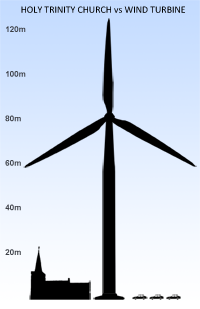
Holy Trinity Church, mentioned in the Domesday Book of 1086, has dominated the Swift Valley for 1,000 years. Above is an accurate representation of the relative sizes of the church spire and the proposed monstrous turbines that will vandalise the heritage of the area.
Donate Now!
Please donate now to help pay for a lawyer to represent the community at the Called-In appeal hearing.